
The Woodlands Domestic Violence Lawyer
A Domestic Violence Arrest Can Change Your Home Life Before Your Case Is Decided
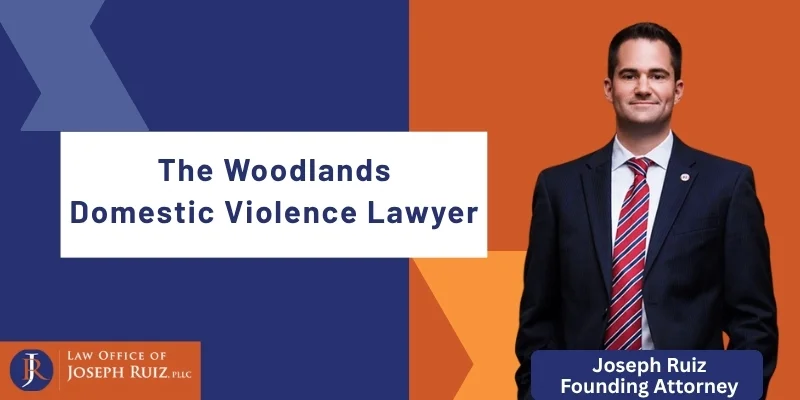
A domestic violence arrest can affect where you live, who you can contact, and how you see your children before a judge ever decides whether you committed a crime.
Police may make an arrest without a warrant, bond conditions can restrict your movements, and a protective order can create immediate rules for your home and family.
Those first decisions deserve careful attention.
The Law Office of Joseph Ruiz, PLLC represents clients facing family violence allegations throughout The Woodlands and Montgomery County. Joseph Ruiz, The Woodlands Domestic Violence Lawyer has taken more than 325 cases to trial in Texas courtrooms, including cases that resulted in not guilty verdicts. That trial experience shapes how we examine the evidence, challenge disputed accounts, and prepare each defense from the beginning.
If you have been arrested or accused of family violence, contact our office to discuss the charge, the restrictions already in place, and the decisions that need attention now.
| 325+ Jury Trials | Avvo 10.0 Rating | Super Lawyers 2023-2026 | Bilingual: English & Spanish |
Texas Family Violence Charges Require a Defense Built Around the Actual Allegation
The phrase “domestic violence” can describe several different criminal charges.
The facts alleged, the relationship between the people involved, prior convictions, claimed injuries, and the presence of a weapon can all affect how the State approaches the case.
The Law Office of Joseph Ruiz defends clients against allegations including:
- Assault Family Violence, which is commonly charged as a Class A misdemeanor for a first offense
- Aggravated Assault Family Violence, which may be charged as a felony when the allegation involves serious bodily injury or use of a deadly weapon
- Assault Family Violence by Strangulation, a felony allegation involving pressure to the throat or neck that impedes normal breathing or blood flow
- Continuous Violence Against the Family, a felony charge based on allegations involving two or more acts of family violence within a 12-month period
- Violation of a Protective Order, which can create additional criminal exposure when the State alleges that an existing order was violated
- Interference with an Emergency Call, when prosecutors allege that someone prevented or attempted to prevent another person from requesting emergency assistance
The charge listed on your paperwork is only the starting point. We examine the underlying allegations, the available evidence, prior history, witness accounts, recordings, photographs, medical records, and police documentation to determine how the State may try to prove its case.
What Happens After a Family Violence Arrest in Montgomery County?
The legal process can begin moving before you have had an opportunity to understand what the accusation means.
Texas law provides special procedures for certain family violence arrests. After bond is posted, a person arrested for a family violence offense must be held for four hours when officers have probable cause to believe another act of violence is likely.
A magistrate may extend that period for up to 48 additional hours through a written order if specific legal requirements are met.
The potential criminal penalties also vary substantially by charge.
A first offense commonly prosecuted as Class A misdemeanor assault under Texas Penal Code Section 22.01 can carry up to one year in county jail and a fine of up to $4,000.
An allegation involving strangulation or suffocation can result in a third degree felony charge, which carries a potential sentence of two to ten years in prison.
The consequences can extend beyond the sentence itself. A conviction may affect employment, professional licensing, firearm rights, and family-law proceedings. That makes the early stages of the case important even when the accusation does not involve serious physical injury.
Our role is to understand what evidence exists before decisions are made that could narrow your options later.
Protective Orders Can Create Immediate Restrictions on Your Life
A criminal case and a protective order are separate legal matters, but they can overlap in ways that create serious practical consequences.
In Montgomery County, a family violence allegation may lead to an emergency protective order or another protective order proceeding. The order can restrict communication, control where a person may go, affect access to a residence, and impose restrictions involving contact with children. Violating the order can also create a separate criminal matter.
Texas Family Code Section 85.001 requires a court to issue a protective order if it finds that family violence has occurred.
Protective-order filings and felony family violence matters in Montgomery County are handled through the county court system, including proceedings involving the District Clerk’s office in Conroe.
Preparation matters before that hearing. We review the allegations and supporting material, including police reports and available 911 recordings, and work to understand your account of the events before presenting your position to the court.
The Evidence May Tell a More Complicated Story Than the Arrest Report
Family violence allegations often involve two people describing the same event very differently. A police report records what officers were told and what they observed. It does not by itself establish every fact that the State must prove at trial.
Our review may include:
- Statements made by the accused and alleged victim
- 911 calls and other recordings
- Body-camera footage
- Photographs of claimed injuries or property damage
- Text messages, emails, and other communications
- Medical records
- Statements from witnesses
- Prior allegations or documented incidents
- Protective-order paperwork
- Physical evidence collected by investigators
We look at how those pieces fit together and where the State’s evidence may be incomplete, inconsistent, or subject to challenge.
The objective is to understand the case the prosecution has and determine how it can be answered.
A Family Violence Case Can Affect More Than the Criminal Docket
The criminal charge may be only one part of what you are dealing with.
A protective order can affect contact with your spouse, partner, children, or other family members.
A pending allegation may also become relevant in a custody or visitation dispute.
A conviction can carry consequences for firearm ownership, employment, professional credentials, and future criminal cases.
Family violence arrests can also involve additional allegations from the same incident, such as a drug crime or DWI charge, and each one can change the options available in your case.
That overlap makes coordination important. Decisions made in the criminal case can have consequences in related proceedings, so your defense should account for the broader situation rather than treating the arrest as an isolated event.
If a custody case, protective order, or other proceeding is already underway, tell your attorney. Those details can change how the defense needs to be approached.
FAQ’s About The Woodlands Domestic Violence Laws
Do I need a lawyer before my first court date?
It is worth speaking with a criminal defense attorney as soon as possible. Statements to investigators, bond conditions, protective-order proceedings, and other early decisions can affect the direction of the case.
Can a domestic violence charge be dismissed if the alleged victim does not want to prosecute?
The alleged victim does not control whether criminal charges continue. The State of Texas decides whether to pursue the prosecution. Depending on the evidence, prosecutors may continue even when the complaining witness does not want to participate.
Is every domestic violence charge a felony in Texas?
No. A first offense of assault family violence is commonly charged as a Class A misdemeanor. Certain circumstances can increase the charge, including qualifying prior convictions, allegations involving strangulation, serious bodily injury, or a deadly weapon.
Can a domestic violence conviction affect my firearm rights?
Yes. Certain family violence convictions can create federal and state restrictions involving firearm possession. The specific consequences depend on the offense and the circumstances of the conviction.
What can happen at a protective order hearing?
The court may consider evidence concerning the alleged family violence and determine whether a protective order should be issued. Depending on the order, restrictions may address residence, communication, contact with family members, children, and firearms.
Will a family violence charge affect my child custody case?
It can. Family courts may consider allegations and findings involving family violence when making decisions concerning conservatorship, possession, and access. The effect depends on the facts and procedural posture of the family-law case.
Can a family violence case be sealed or kept off my record?
The answer depends on the specific disposition and applicable Texas law. Family violence cases can face restrictions that do not apply to other misdemeanor offenses, so you should review the exact charge and outcome with a Texas attorney before assuming an expunction or nondisclosure is available.
Do you represent Spanish-speaking clients?
Yes. Joseph Ruiz is fluent in English and Spanish and represents clients directly in either language.
Get Legal Guidance Before the Case Moves Further
You do not need to have every detail organized before contacting a lawyer.
Bring the paperwork you have, explain what happened from your perspective, and let the attorney identify the issues that require immediate attention.
The Law Office of Joseph Ruiz, PLLC represents clients facing domestic violence allegations in The Woodlands and throughout Montgomery County.
Contact the firm to arrange a confidential consultation and discuss the charge, any protective-order restrictions, and the legal steps ahead.
How can we help you
To get your free consultation started, please call
281-300-8695 or fill out the form below and
we will get back to you as soon as possible.
Schedule a Consultation
Testimonials

Anytime you're in need of a lawyer obviously you're going through something challenging, trying and most of the times unexpected... The law office of Mr Ruiz seems to know this first hand. From the first…
Michael Felix
Mr. Ruiz is an excellent attorney and a wonderful person who saved my life. I got entangled in two cases(felony and misdemeanor). I was clueless how to handle the situation. Fortunately I came across Mr.…
Manju Ram
Mr. Ruiz managed my DUI case and got it dismissed like a champ!!! When I got pulled over and was subjected to the procedure, it built a lot of nervousness, anxiety and fear. I talked…
Ron Anonymous
Honestly, i have relationships with lawyers that have met in the past and i had yet to meet Mr Ruiz. Im from out of town and got recommended to Mr Ruiz because my lawyer from…
Tony Torres
Before contacting Mr. Ruiz I had no idea what the outcome of my case would be. He made sure I understood everything that was going on throughout the entire legal process and was easy to…
cannon woodward
I have enjoyed Mr. Ruiz handling my husband's case. He assured me that he would not disappoint us, and he kept his word. It was a joy and peace knowing that everything would work out…
Sharon Thomas
Mr Ruiz is a fighter!!! Reduced my felony DWI down to a class B misdemeanor!! Was extremely relieved with the outcome and made the long court process go by smooth! Will definitely recommend!10 stars!!!
Junbugg Sanchez
Let me first say I am THANKFUL to have of found the right attorney to help me with my situation. There are so many attorneys out here that will give you the run around on…
Amber Rose Martinez
I highly recommend Mr.Ruiz as he is very good at what he does. He has wonderful responsiveness and he ultimately got my felony dismissed right before Christmas! Having Mr. Ruiz on my side was the…
megan reid
I STRONGLY recommend Mr. Ruiz! After being charged with my first DWI i contacted Mr. Ruiz. Mr. Ruiz would constantly keep me updated and would always go that extra mile. Although i had what seemed…
Mariano
I can't thank Joseph Ruiz enough for his professional, personal attention and care he put into a difficult situation with my son. The outcome he was able to negotiate for the case was unexpected and…
Mark G
Mr. Ruiz was very helpful and straight forward. Got my 2nd Dwi case dismissed. Definitely will be recommending him to anyone that needs a lawyer for this or similar situations.
Jaime Moncivais
First class service from start to finish (dismissal). Excellent communication and knowledge put my mind at ease during the process. Joseph Ruiz deserves his excellent reputation!
Carl Emery
I highly recommend Mr. Ruiz! I'm extremely thankful to have had Mr. Ruiz representing me. I am very pleased with the outcome of his hard work and turning a felony into a misdemeanor. Thank you…
C Gonzalez
The process for my case was extremely smooth from beginning to end. All of my questions where answered, constant communication throughout every step. I am very grateful that I chose to work with Joseph Ruiz.
carmen damian
Best lawyer in town hands down! He will get you the best result possible while keeping you well informed on every possible outcome and decision. Highly recommended!
Emmanuel Opara
I would highly recommend Mr. Ruiz to anyone, he is a very good at what he does and definitely proved himself to be someone you want on your side representing your case. When I came…
Julian Quintanilla
I want to take the time and give my full appreciation and thank you to Attorney Joseph Ruiz. Being my first time offense I was lost in who to trust to represent my case. I…
luis Mondragon
I just want to thank The Joseph Ruiz Law Firm for taking my case even though it stepped over the county line. I reached out to this particular law firm by recommendations from several Harris…
Santiago Vazquez
Joseph just got my case dismissed today. Thank you for your helps. We would highly recommend Joseph to our friends and family members if they are in need of a lawyer.
Loc H
Joseph Ruiz is truly a life saver! I am a wounded warrior with PTSD and he fought to the bone to get me the best justice and verdict. DISMISSAL!! He communicated with me weekly and…
Sharea North
At a time of difficultly when your faced with a family member charged with a 1st offense. You never know which attorney you can trust with the life of your family member who is young…
Patricia Herrero
Mr Ruiz is the best criminal defense Attorney. Hands down no doubt. If you have any criminal charges you facing please refer to the law office of Joseph Ruiz because your case is in good…
Umoru Inu umoru
A very compassionate and detail oriented lawyer. Mr. Ruiz was able to fight and beat my case in a timely manner. Mr. Ruiz is someone who was with me the whole process, his communication set…
mostafa hadab
I was so stressed out about my case, it took me a couple months after my first court date to find a good lawyer plus with money wise and he accepts monthly plans! He did…
Vanessa Escalante
I am very appreciative of Mr. Ruiz’s professionalism, knowledge an experience. He will instill confidence in you immediately upon meeting with him. Communication with him is excellent and he is great at explaining processes with…
Brian Hinkle
Joseph Ruiz is an exceptional attorney. He is professional, courteous, diligent, and experienced. He knows the law, and he treats his clients with respect and dignity. When you hire Joseph, you can trust you will…
Drew Prisner
Best decision I have ever done was hire Mr. Ruiz. He was able to get me a dismissal on an assault charge with a previous conviction. He gave me his cell phone number since day…
Ricky Rodriguez
Knowledgeable, methodical, concise, ... Mr. Ruiz is by far THE most effective and professional attorney I have ever dealt with. He handles his cases all by himself and will not forget about you. Mine took…
JESSE CARMICHAEL
Hire him! After contacting numerous attorneys in the area regarding a fairly new law, and being told I had no chance, I am so glad I found Joseph Ruiz! He was immensely knowledgable, answered the…
Natalie Alanis
Hire Mr. Ruiz he is a very professional and an amazing lawyer. After catching a dwi charge I was very worried especially about my status because I was a permanent resident at the time but…
Glody Mawana
Joseph Ruiz is an extremely knowledgeable and professional lawyer. He makes sure you get personalized one on one service and is someone you can entrust with your case. He went above and beyond for me.…
Kristina Rose Pretzsch
Mr. Ruiz is an exceptional attorney and is amazing at his job. I cannot have been more pleased with the results. He helped me get my DWI case dismissed during pre trial! I never even…
Cesar
Joseph is not only extremely knowledgeable on all aspects of criminal law, but he is fearless in fighting for his clients. He is an excellent attorney committed to providing the highest quality of representation to…
Jacqueline Michel
Joseph Ruiz is one of the best DWI & Criminal defense attorney! He really cares about his clients and goes the extra mile. If you are ever in trouble with a criminal case Joseph is…
Roy Rolong
I worked with Joseph Ruiz for close to a decade. His office was next to mine. I witnessed him work late nights and long hours going over videos and reports and other evidence in preparation…
H. King
I have to say that Mr. Ruiz was recommended to me from a friend. I also to the time to check out his record. I was very impressed. Mr. Ruiz is very straightforward and is…
Tim Mccray
Amazing attorney! Would recommend him in a heartbeat. He is thorough, extremely knowledgeable, cautious, and patient. He cares for his client and fully engages his efforts in your case. Do not hesitate in contracting his…
Adriana Rubin
Joseph Ruiz explained very well my options each court date. He always gave me his opinion on what was best. Most of all what I enjoyed was the great communication he provided. There was no…
Andy Arroyo
Positive: Professionalism, Quality, Responsiveness, Value I’d highly recommend Mr. Ruiz! He’s very professional and takes care of his clients. I didn’t see my way out of my situation at first but he definitely kept everything…
Jesus Munoz
Joseph is one of the hardest working attorneys I have ever had the pleasure of coming across. He is diligent in his work ethic and is one of the finest trial lawyers that I have…
Tej Paranjpe
I got into a situation where I had two DWI cases pending at the same time. Mr Ruiz dismissed both of them in a period of 3 months. He kept me updated with what’s going…
Miguel Martinez
I recommend 100% to all people who need the services of a lawyer for their excellent professionalism. My family and I are very grateful for having him defend our case. Do not hesitate to contact…
Carlos Manuel Valdivie
I couldn’t be any happier than to have been found NOT GUILTY at the Brazoria County court house after Mr. Ruiz had my case for 2 years. Mr. Ruiz was very professional and could not…
Adrian Cardenas
You’re such a brilliant lawyer. Thank for helping me through this tough time and aiding a new beginning of my life I am so grateful for your passion, dedication, and professionalism. You are truly the…
MustaFa Khan
Mr. Ruiz is extremely professional and will handle case with skill and efficiency. His guidance and advise are trusted and reliable. His personality is calming and assuring.
Ola Olaleye
If you are looking for an honest attorney who will truly fight for you and do what is in your best interest, I recommend you hire Joseph Ruiz. I referred a person to him who…
Diana Perez
I can't say enough about Joseph Ruiz! Not only was he helpful and super informative about the possible outcomes of my case, but I was able to call him after hours about any concerns or…
Liberate Your Mind
Joseph has a well-earned reputation as one of the best criminal defense attorneys in town. He knows the law inside and out and fights for his clients. As a result, I've seen him get excellent…
José Ceja
Joseph Ruiz was extremely diligent and knowledgeable of the law pertaining to my case. Mr. Ruiz was able to have my DWI case dismissed as well as winning my ALR hearing. Saving me from having…
Skaught Yourke
Joseph was there for me during one of the scariest times of my life. He has been reassuring, confident, efficient and did what he said he was going to do, however, he never over promised.…
Omar Naboulsi
The man of the Hour. Joseph Ruiz did exactly what he had promised me. Got my case dismissed. Very thankful and greatfull to have hired him as my attorney. Definitely
Joe “P” Varghese
Mr Ruiz is elequent, understanding swift and knowledgable. He has a calming presence in the midst of the courtroom circus. He helped me get a dismissal with case that could have gone much worse without…
micah Rideout
100% totally trust this guy. The best attorney around and will not stop fighting for you. Not a plea deal kind of guy. I recommend him to any and all who are in need of…
Adam V
After running into some trouble and finding Joseph through his great Google reviews I hired him. I am so pleased with the outcome, he made the process easy and breezy for such a horrible time…
Frankie Trevizo
Joseph has helped two of my uncles from both sides of my family through some tough times. One uncle was on his second or third offense in Harris County and was looking at serious jail…
rey davila
I would recommend Joseph to anyone because he is very professional and fair and simply gets you the outcome you not only want, but deserve. He was reachable and available whenever i needed to talk…
Roger JnMarie
Got A DWI dismissed thanks to Joseph's help. From pre-trial intervention program that I was getting first and then to a full DWI conviction, my case got dismissed! It feels really good. Joseph is an…
Chris R
I have no words to describe the outsatnding work of Mr Josehp Ruiz. No only he got my case Dismissed but he made the process easy and confident enough so I would'nt loose my sleep…
Carlos Osorio
Great lawyer ! Great results ! Very professional always kept me updated on my case, genuinely cares about clients. Definitely recommend!
Alexis Zavala
Mr. Joseph Ruiz has represented my son in several occasions and he has gotten almost all of them dismissed. I highly recommend Mr. Joseph Ruiz to any one in need of a great and sharp…
Petro One
Mr Ruiz is so awesome he was recommended by my friend I fired my lawyer and hire him and don't regret it at all he is so encouraging I was very worried about my case…
Lisa Hamilton
My family and I are very grateful for having him defend my brother's case. Not at all Heroes wear capes, some wear suits. My family and I can't thank him enough. I just wish him…
Eduardo Miranda
Mr. Ruiz was very informative and kept me updated on the whole process. He made the whole ordeal as easy and painless as possible.
Jose Quintana
Best lawyers in Houston!! He is sharp and very detailed lawyer. When he says he is going to do something trust me he is going to get it done with a fight!! And he is…
Winston Johnson
1000% recommended! He is very patient, professional, and tentative with his clients. Got a dismissal with him and his teams hard work. Thank you again! Hands down the BEST law firm.
Cassidyyy Schroeder
Excellent lawyer Very responsive and excellent litigator, have used him a couple of times and he has done a great job for very reasonable fees. Would definitely recommend to anyone that's looking for a good…
Hakim R
From the moment I contacted Mr.Ruiz I knew he was the right lawyer to hire, he would always keep me updated on my case and I could not thank him enough.
lsbugsbunny92
I will recommend Mr ruiz 100% to everyone who get a ticket he is a good lawyer he dismissed my husband dwi case fast that i expected he is a good professional lawyer and he…
Marco Mendoza
VERY THANKFUL WITH MR RUIZ I APPRECIATE EVRYTHING HE DID IN MY CASE..I RECOMMEND HIM..HIS THE BEST
Maria Maynez
He did a great job! He was very informative and helpful throughout the process! Very satisfied!
Darryl Tracy
One of the best lawyers very adaptable and understandable helps you in what he can and this at his fingertips won my DWI case with the best options and benefits.
Karen Rivas
He explains everything very well, step by step. Very satisfied with his work, it is worth hiring professional attorneys like Joseph Ruiz. Thanks
Carlos Loza
Without words, he was very attentive to his work. I take off my dwi in a very short time. I recommend it for people who care whoever helps them, it is definitely him. Thank you…
Miguel Hernandez

Schedule A Consultation
Fill out the form below to get in Touch


© Copyright 2026 Law Office of Joseph Ruiz, PLLC All rights reserved.
*Images are obtained under license from Canva and other third-party stock image providers, with attribution included where required.
Digital Marketing By 